


There’s endless advice about how to replace your SEO team with AI agents.
Ahrefs even launched Agent A: but why would they do this? I thought SEO vendors and agencies were cooked? Well, not so fast.
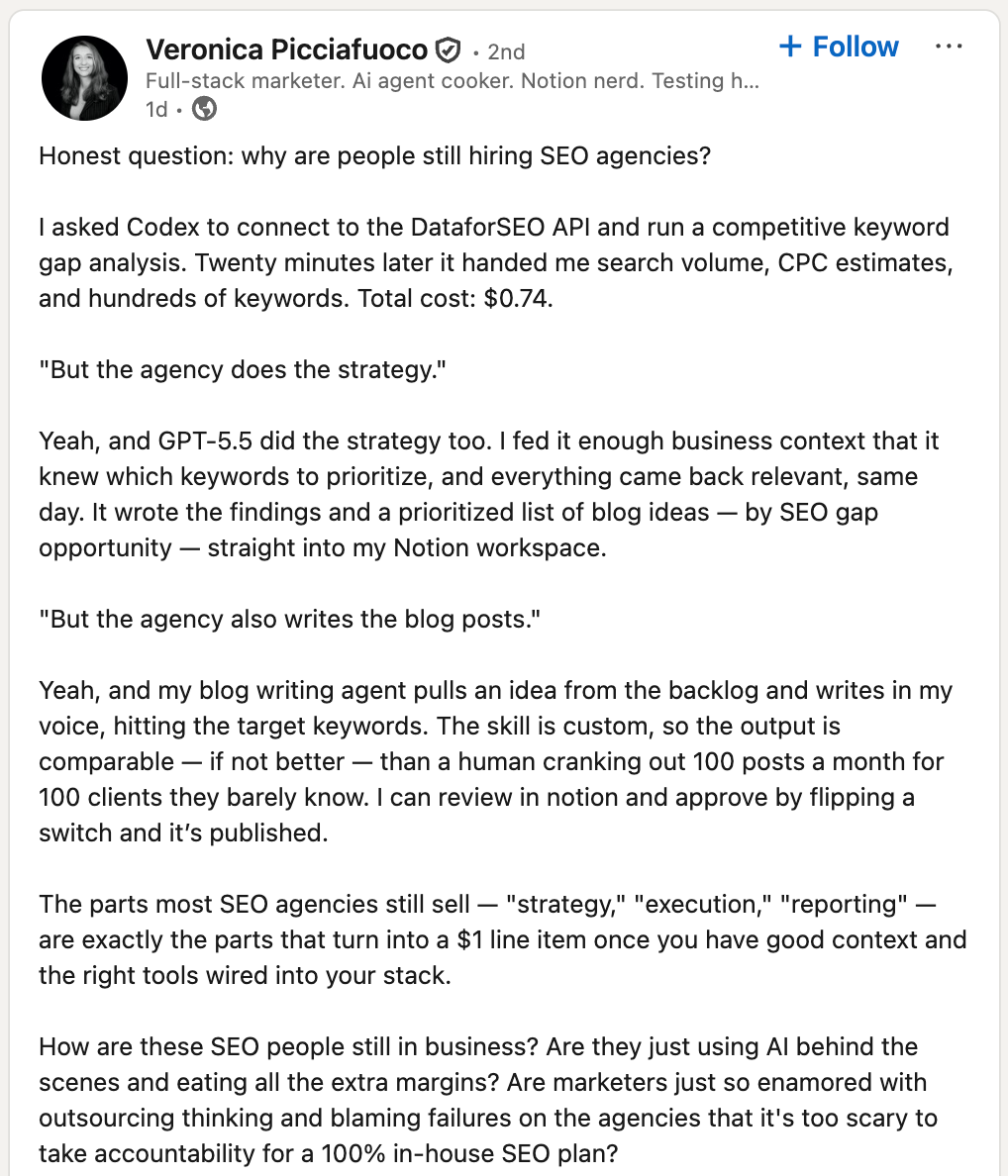
First, let’s examine this rage-bait LinkedIn post that came across my feed. This one is sooooo misguided that I had to address it directly.
Here it is:
AI can complete common SEO tasks. It still can’t own the number.
SEO is not a checklist. It’s a strategic brand-dependent revenue channel.
And there is a massive difference between task completion and owning the commercial outcome of the SEO channel.
That difference is where the entire argument falls apart.
AI agents are very good at completing defined tasks. They can cluster keywords. They can analyze competitors. They can draft content briefs. They can automate mundane aspects of SEO reporting.
But AI agents cannot own the number.
Task completion is not why CMOs hire agencies
CMOs hire experts because the opportunity cost of getting the channel wrong is too painful.
Owning organic growth often means deciding what NOT to do.
It means understanding which traffic is meaningless, which keywords attract buyers, which pages should never be created, which technical changes are risky, and which opportunities look good in a spreadsheet but will never translate into business value.
It means understanding the dark SEO funnel and how to draw the connection to revenue outcomes: (see my post on Dark SEO below)
First, Dark Social. Now, Dark SEO.

This post contains real examples from my client work. It’s exclusive knowledge that’s hard to find. So if this post delivers value, I’d love a subscribe. 🙏
Just because you can outsource it, doesn’t mean you should
This guy makes another interesting point. CMOs are way too busy to deal with the program management of SEO.
Whether AI agents are involved or not, you still need someone driving the tool to execute the program.
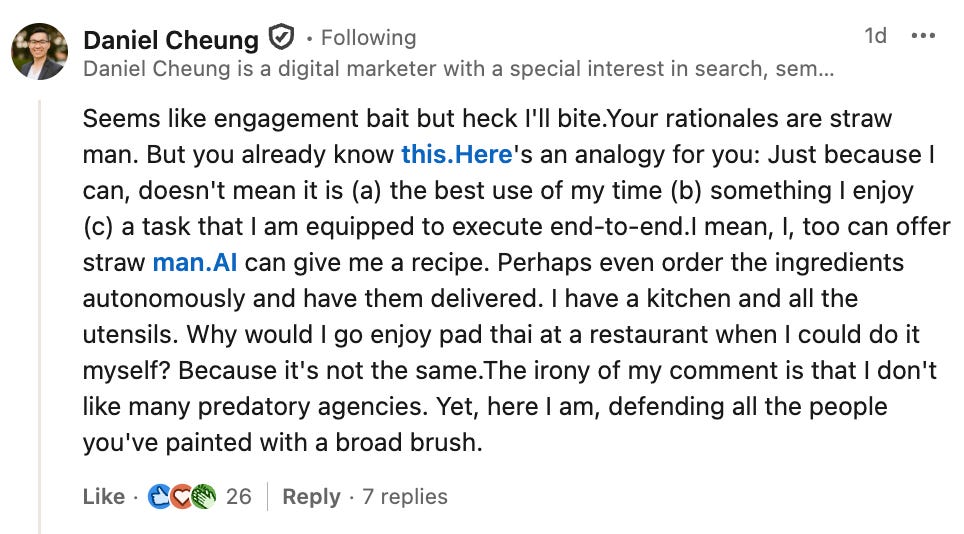
What CMOs actually want from SEO experts:
I’ve worked with enough VPs and CMOs to know they ultimately want strategic thinking and accountability:
Here’s some examples of what they want:
CMOs want someone to interpret the data and explain the narrative.
CMOs want to know if organic traffic is up, but sales-qualified pipeline is down. Is that an SEO problem, an ICP problem, a conversion problem, a sales follow-up problem, or a positioning problem?
CMOs want to know when a keyword with 90 searches a month is more valuable than one with 9,000.
CMOs want to know when the right move is to build more feature pages rather than blogs.
CMOs want to know why PPC campaigns are cannibalizing SEO.
CMOs want to know why producing more content won’t solve their visibility problems.
CMOs want to know if they have a tactical GEO problem or a category positioning problem.
GEO is a CMO Problem. Not an SEO Problem.

It took me 6 hours to write this post! If it provides value, I’d appreciate a subscribe 🙏
AI can produce analysis. It cannot carry accountability.
Most importantly, AI agents cannot walk into the boardroom and explain why organic sourced pipeline missed by 40%.
They cannot take responsibility for betting six months of content and engineering resources on the wrong market segment.
They cannot take responsibility for “Rank and Tank” strategies that ultimately backfire.
They cannot manage the politics between marketing, product, comms, brand, RevOps, and leadership.
AI enables the smartest SEOs to perform tasks faster, better and more efficiently.
But at the end of the day it’s just task completion. Owning the entire channel is a very different game. Anyone that’s been in the trenches knows this.

100%. I sat in on a well known end to end AI tool pitch today as an advisor. Client VP and CMO thought it was interesting, but aren’t going to be in the tool building workflows and getting nearly enough out to justify the (very high) cost. So the advisor is still driving the strategy…
So good